
A Step-by-Step Guide for Expats (2026)
So you’ve made the move to the Czech Republic — or you’re planning to. You’ve found a flat, maybe started a job, and now someone mentions you need a “temporary certificate.” Suddenly there’s a pile of Czech bureaucracy in front of you and you’re not quite sure where to start.
Don’t worry. This guide will walk you through everything clearly and simply. No legal jargon, no stress.
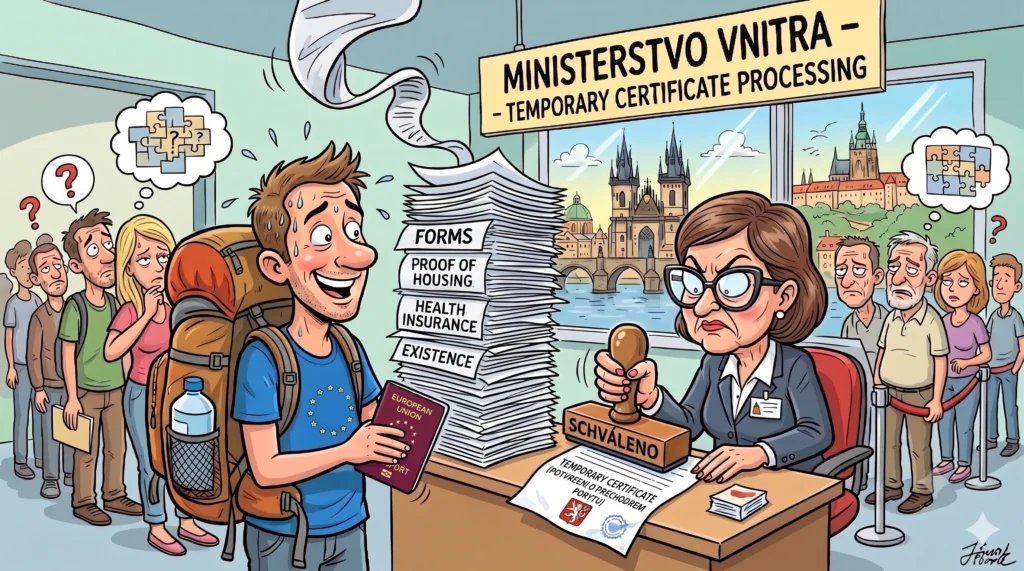
What Is the Temporary Certificate (and What Is It Called Now)?
The document you’re looking for has had a bit of a name change. It was officially called the Certificate of Temporary Residence (Potvrzení o přechodném pobytu in Czech), but since August 2021 it has been renamed the Registration Certificate (Registrační certifikát). You’ll hear both names used — they refer to the same document.
It is an official document issued by the Czech Ministry of the Interior (MOI) that confirms you legally reside in the Czech Republic. Physically, it’s a folded A5-sized paper with your personal details and an official stamp. Simple, but surprisingly important.
Do You Actually Need It?
If you’re from an EU country, Iceland, Liechtenstein, Norway, or Switzerland — technically, the Registration Certificate is not mandatory to live and work in Czech Republic. You are legally required only to register with the Foreign Police within 30 days of arrival. That’s it, by law.
However, in practice, you will almost certainly need it at some point. Here’s when it becomes essential:
- Opening a Czech bank account — most banks require it
- Getting a trade license (živnostenský list) if you want to freelance or be self-employed
- Proving tax residency to Czech or foreign authorities
- Bringing a non-EU partner or spouse to live with you — they’ll need your certificate as part of their application
- Applying for Permanent Residence after 5 years — having the certificate makes proving continuous residence much easier
- Enrolling children in Czech schools
- Accessing certain public services
One important heads-up: registration may become mandatory in 2027. Around 200,000 EU citizens in Czech Republic still haven’t registered, and the government is expected to change that. Getting it now, before the rush, is a smart move. If you want to bypass the upcoming bureaucracy entirely, you can apply for your registration certificate with Wise Expats.
Documents You’ll Need
Gather these before your MOI visit. Documents marked with (*) must not be older than 180 days:
- Completed application form — available on the Information Portal for Foreigners or at the MOI office
- Health insurance
- Valid passport or national ID card
- One passport-size photo (not older than 180 days)*
- Proof of accommodation in Czech Republic — a rental contract, landlord’s written confirmation, or property deed*
- Proof of purpose of stay (if applicable):
- Employment: work contract or employer confirmation
- Self-employment: trade license or business registration
- Study: enrollment confirmation from your university/school
- Administrative fee: 200 CZK — payable at the MOI
- Birth number application form (rodné číslo) — the MOI will assign you a Czech birth number
Step-by-Step: How to Apply
Step 1 — Gather Your Documents
Start collecting everything from the list above. Give yourself at least a week, especially if anything needs translating. Check that all documents are within the 180-day validity window.
Step 2 — Find Your MOI Office
You must go to the Ministry of the Interior office (DAMP — Department for Asylum and Migration Policy) that covers the area where you live. You can find the right office on the ipc.gov.cz portal.
Step 3 — Submit Your Application
You have three ways to submit:
- In person at your local MOI office — recommended if you’re not confident about your documents. Bring a Czech-speaking friend if you can. Book an appointment in advance to avoid long waits (without an appointment, expect around 3 hours — go early, before 8 AM, as offices fill up fast).
- By post — many expat relocation advisors prefer this method as it’s more convenient. Send by registered mail and keep your tracking number.
- Electronically — via Data Box (datová schránka) or email with a recognised electronic signature.
Step 4 — Wait for a Decision
The MOI officially has 30 days to make a decision. During this time, they may send you a letter requesting additional or corrected documents. If they do, respond before the deadline — otherwise your application will be rejected.
Step 5 — Collect Your Certificate
Once approved, you’ll need to visit the MOI office in person to collect your certificate. That’s it — you’re officially registered.
How Long Is It Valid?
The Registration Certificate is valid for 10 years. After that, you cannot extend it — but you have two options:
- Apply for a new Registration Certificate (start the process again)
- Apply for Permanent Residence — if you’ve lived continuously in Czech Republic for 5 years, this is the stronger long-term option and can eventually lead to Czech citizenship
Common Mistakes to Avoid
These are the most frequent reasons applications get delayed or rejected:
- Documents older than 180 days — check every date before you submit
- Missing proof of purpose — if you’re employed or self-employed, always include that documentation
- Not reporting changes — once you have the certificate, you must notify the MOI within 30 days if you move to a new address, and within 15 days for changes like a new passport or marital status
- Going without an appointment — the MOI offices can be very crowded; booking ahead saves hours
- Submitting the Wrong Proof of Accommodation — Always check the Cadaster before signing a lease
What Happens After You Get It?
Having your Registration Certificate opens doors. You’ll be able to get a Czech bank account, get better morgage rates, prove tax residency, and build your paper trail for permanent residence down the road. It also gives you peace of mind — you’re officially on the books.
FAQ: What Expats Are Googling About This
Do I need a Czech address before I apply?
Yes. You need proof of accommodation — a rental contract or a proof of accommodation from your landlord is usually enough.
Can I apply if I just arrived in Czech Republic?
Yes, you can apply at any time. For EU citizens, there’s no strict deadline, though you should register with the Foreign Police within 30 days of arrival.
What if I don’t speak Czech?
The MOI offices operate in Czech. Some offices have intercultural workers who can assist in English, but it’s not guaranteed. Instead of relying on luck, you can hire Wise Expats to manage your relocation process. We handle all communication with the ministry, ensure your documents are perfectly translated, and accompany you to make sure your collection process goes flawlessly.
Will it become mandatory in 2027?
It’s expected to, though not yet confirmed. Given that the Czech government has flagged this and around 200,000 EU residents still haven’t registered, it’s wise to do it proactively now.
What if I don’t have a lease yet or my landlord refuses to sign the paperwork? You cannot apply without a legally certified address. If you are stuck between apartments or dealing with an uncooperative landlord, Wise Expats provides official, ministry-approved to secure your application instantly.
Do I need to apply for a Czech birth number (rodné číslo) separately? No. The MOI requests it automatically when you apply for your Registration Certificate. It takes 1–3 months to process. Once generated, you must visit the MOI office in person to collect the your Czech number.
What is included if I choose to work with Wise Expats? You get the best relocation service in town for a guaranteed fixed price—we flawlessly handle all your forms, secure your appointments, track your application, and walk you through the ministry so you can entirely skip the stress and the lines.

Leave a Reply