
Choosing the Right Financial Proof for Your Czech Visa
Before you pack your bags for the Czech Republic, the embassy needs to see that your day-to-day budget is covered. Whether you are coming to study or work, submitting official Proof of Funds (Doklad o zajištění prostředků) is a standard part of the checklist.
Applicants commonly get caught between two options: a Bank Letter (an official account confirmation) and a Bank Statement (a periodic transaction log). While both satisfy the financial requirement, Czech embassies and the Ministry of the Interior (MOI / OAMP) evaluate them differently depending on where you submit your application.
At a Glance: Bank Letter vs. Bank Statement
| Feature | Bank Letter (Account Confirmation) | Bank Statement (Transaction History) |
|---|---|---|
| Document Length | Single-page official summary | Multi-page breakdown of monthly cash flow |
| Issuance Method | Issued, stamped, and signed by a bank branch officer | Downloaded directly from online banking or printed at a branch |
| Certified Czech Translation | Mandatory Across almost all embassies & domestic OAMP filings | Waived at U.S. Consulates Required in most other jurisdictions |
| Key Information | Total available balance, account currency, and verified owner’s name | Line-by-line debits, credits, opening and closing monthly balances |
| Translation Cost | Low Only 1 page to translate | High If multi-page (Unless only summary page is translated) |
What Is a Bank Letter?
A Bank Letter (often titled Verification of Deposit or Account Confirmation) is a formal letter generated by your bank branch manager or customer service officer.
What the Letter Must Include:
- Account Holder’s Full Name: Must match your passport spelling exactly.
- Account Number & Account Type: Checking or savings account.
- Total Current Balance: Stated in local currency (e.g., USD, EUR, GBP) with confirmation that funds are liquid and freely accessible abroad.
- Bank Details: Official letterhead, physical signature, contact information, and an ink stamp from the branch.
Translation Rule: Because a bank letter is issued in English or another foreign language, it must be accompanied by an official certified translation into Czech executed by a court-appointed sworn translator (soudní překladatel s kulatým razítkem).
Sample Document: Download a sample Czech Visa Bank Letter (PDF) to see the exact format, wording, and stamp requirements embassies look for.
What Is a Bank Statement?
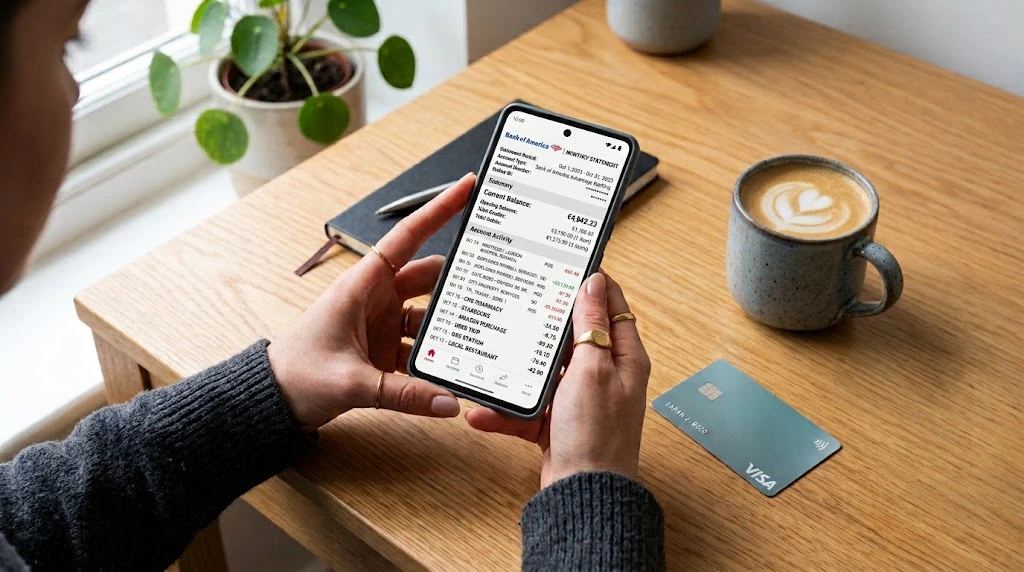
A Bank Statement is the standard monthly report showing all account inflows, debit card purchases, transfers, and total ending balance over a 30- to 90-day period.
Where Bank Statements Are Preferred:
- Czech Consulates in the United States (Washington D.C., New York, Chicago, Los Angeles): U.S. consulates routinely accept standard, downloaded electronic bank statements in English without requiring a certified Czech translation.
- Direct Proof of Stability: Statements prove to consular officers that the balance was not deposited as a single lump sum right before the visa interview.
Best Practice: If submitting bank statements outside the U.S. consular network, request a single-page Statement Summary from your bank rather than translating 10+ pages of individual grocery receipts and daily expenses.
Don’t risk your university enrollment over paperwork errors. Let our local experts compile, audit, and submit your complete Czech student visa dossier.
Minimum Financial Requirements
The Czech immigration authority calculates the required balance based on the statutory Subsistence Minimum (Existenční a životní minimum) combined with basic living expenditure indices.
While thresholds adjust annually with cost-of-living updates, general baseline expectations include:
- 1-Year Long-Term Visa / Student Visa: Approximately 140,000 to 155,000 CZK (or roughly 6,500 to $7,500 USD / 6,000 to 6,800 EUR depending on exchange rates).
- 6-Month Visa: Approximately 90,000 to 105,000 CZK.
- Minors (Under 18 Years Old): Required to demonstrate roughly 50% of the adult financial threshold.
Note: If the account is held in a foreign currency, consular officers calculate the balance against the official Czech National Bank (ČNB) exchange rate on the date of review.
The Mandatory Requirement Most Expats Miss: The Payment Card
Submitting a bank letter or statement alone is not sufficient if your funds are held in a foreign bank.
Czech immigration regulations explicitly require proof that you can access your foreign money while residing in the Czech Republic. You must provide:
- A copy of an internationally recognized debit or credit card (Visa, Mastercard) issued in the applicant’s name and linked directly to the submitted bank account.
- Physical presentation of the card: You may be asked to show the physical plastic card during your consulate interview or biometric appointment.
Applying for an Extension? Switch to a Czech Bank Account
If you are already living in the Czech Republic on a valid visa and preparing for an extension of stay or change of purpose at the Ministry of the Interior (OAMP):
- Avoid Translation Fees Entirely: Czech bank statements (from banks like Fio, ČSOB, Air Bank, or Raiffeisenbank) are generated natively in Czech and accepted immediately without third-party verification.
- Prevent Currency Fluctuation Risks: Funds stored in Czech Koruna (CZK) eliminate the risk of currency dips pushing your balance below the statutory minimum during administrative review.
If you need help with opening a Czech bank account, you can check our Czech bank account service page for document requirements, supported banks, and appointment scheduling.
Need Support with Your Czech Visa Application?
Preparing visa documents without errors prevents weeks of processing delays and expensive administrative appeals.
At Wise Expats, we review financial documents, provide certified court translations (soudní překlady), and guide international students and professionals through their full Czech residency and visa filings.
Need Support with Your Czech Visa Application?
Submitting an error-free dossier prevents months of processing delays, formal correction requests, and expensive administrative appeals. At Wise Expats, we audit financial proofs, provide certified court translations (soudní překlady), and guide international students and professionals through their full residency process.

Leave a Reply