
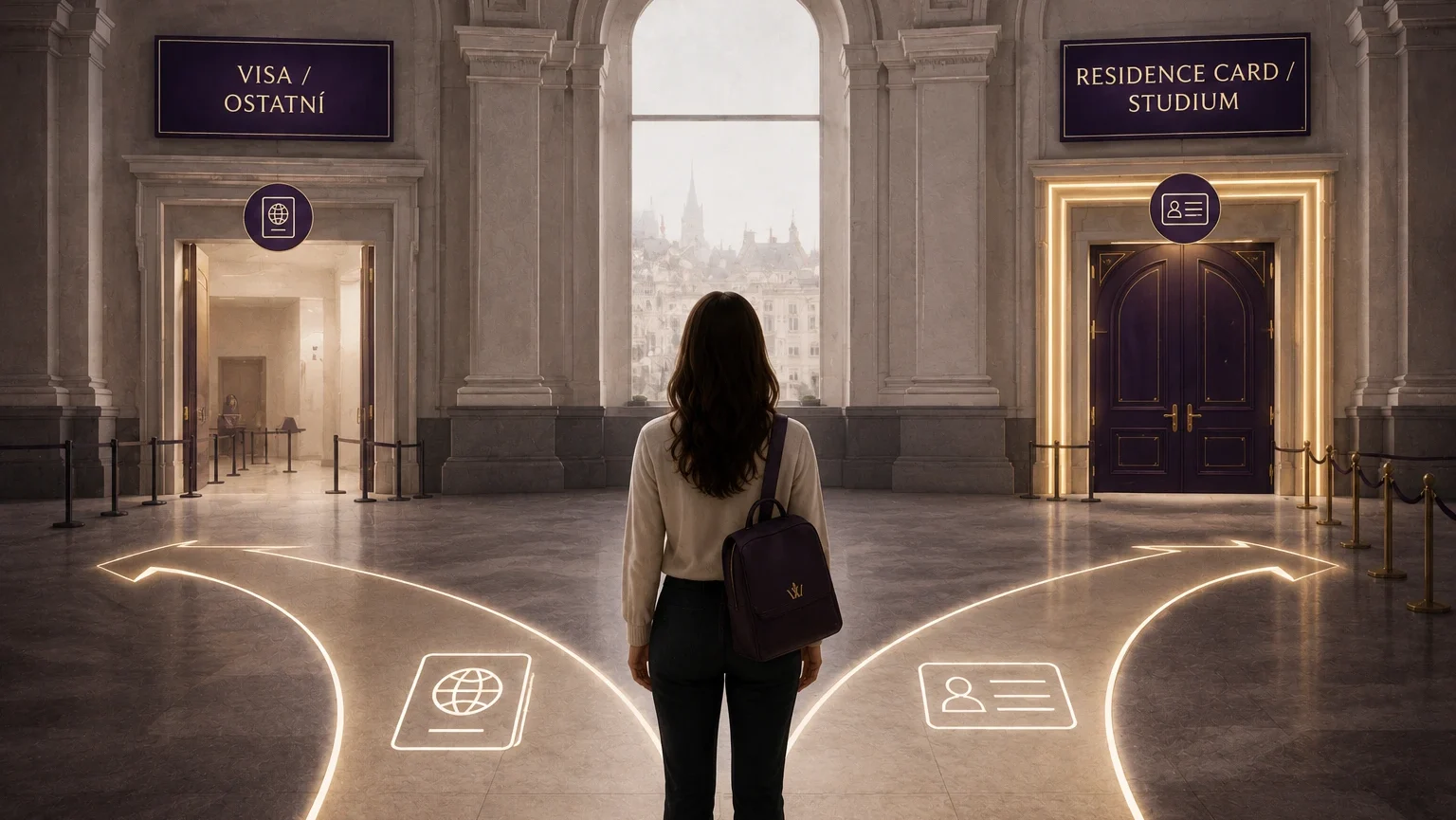
“Studium” vs. “Ostatní” Trap
Planning your move to the Czech Republic as an international student is an exciting journey. You are probably dreaming of Prague’s cobblestone streets, vibrant expat life, and world-class university lectures. But before you can board that flight, you have to face the ultimate boss: Czech immigration bureaucracy.
When applying for your student entry permit, you will quickly find yourself drowning in an alphabet soup of legal terms.
- Should you apply for a Long-Term Visa or a Long-Term Residence Permit?
- Why does your acceptance letter say “Ostatní” (Other) instead of “Studium” (Study)?
- Can you actually work on a student visa?
If you don’t know the answers to these questions, you could easily end up stuck in a category that legally forbids you from getting a part-time job or forces you to leave the country to extend your stay.
Let’s demystify Czech student immigration once and for all. Here is your ultimate guide to understanding the differences, requirements, and the hidden traps of Czech student permits.
Long-Term Visa vs. Residence Permit
Both grant legal stay over 90 days in Czechia, but your study program determines which track you must apply for.
Long-Term Visa
Designed for short-term academic exchanges, preparatory language courses, and non-degree studies.
Long-Term Residence Permit
The standard, flexible pathway for international students pursuing accredited university degree programs.
1. The Long-Term Visa (D/VR)
A Long-Term Visa is a physical sticker placed directly inside your passport.
- Who it is for: Exchange students (such as Erasmus+ or bilateral university exchanges), study-abroad semesters, students attending short-term programs lasting 1 to 2 semesters as well for those enrolled in non-accredited university programs
- The Catch: A Long-Term Visa can only be valid for a maximum of 1 year. You cannot extend a long-term visa indefinitely for the same purpose of stay if it was a short-term tracking program. If you plan to stay longer to transition to a degree, you must apply to transition (“switch”) to a Long-Term Residence Permit while you are still legally in the country.
2. The Long-Term Residence Permit (D/DP)
A Long-Term Residence Permit is a higher tier of legal status. If approved, you will be issued a plastic biometric card upon arrival in Czechia.
- Who it is for: Full degree-seeking students (Bachelor’s, Master’s, or PhD programs) who will be spending multiple years in the Czech Republic.
- The Benefits: It can be renewed repeatedly inside the country (for up to 2 years at a time). Furthermore, having a residence permit makes it much easier to transition seamlessly to a post-graduation “Job Seeker” permit or an Employment Card without having to go back to your home country to apply.
If you are currently a student or planning to study here, you can also explore how these differing permit types directly impact your legal right to work by checking out our guide on Working in the Czech Republic as a Non-EU Student.
The Hidden Trap — Purpose of Stay: “Studium” vs. “Ostatní”
If you only read one section of this guide, make it this one. This is where most international students make a critical mistake that ruins their plans to work or stay long-term.
When you apply for a visa at the embassy, the Ministry of the Interior (MOI) categorizes your application under a specific “Purpose of Stay” (Účel pobytu). For students, there are two distinct categories: “Studium” (Study – Section 64) and “Ostatní” (Other).
Category A: “Studium” (The Golden Ticket)
This category is strictly reserved for students enrolled in programs recognized under Section 64 of the Czech Act on the Residence of Foreign Nationals.
- What qualifies: Accredited degree programs at public or private universities, accredited exchange programs, and official language/preparatory courses run by public universities that are legally certified as “preparatory for university studies” (like Charles University’s ÚJOP program).
- The Perks:
- Free Access to the Labour Market: This is massive. You can work part-time or full-time anywhere in the Czech Republic without needing an extra work permit. Your student status is your work authorization.
- Student Mode (Režim Student): Accredited universities can nominate you for a fast-track embassy queue, drastically speeding up your visa appointment booking.
- Processing Time: Usually a swift 60 days.
Category B: “Ostatní” (The “Other” Trap)
If your course is not officially accredited by the Ministry of Education (MŠMT)—which applies to many private language schools, non-accredited university programs, and standard intensive Czech language courses—your purpose of stay is classified as “Other”.
- What qualifies: Private language academies, certain non-degree diploma programs, or basic preparatory courses not tied to an accredited university path.
- The Pitfalls:
- LOCKED OUT OF A RESIDENCE CARD AT THE EMBASSY: This is the ultimate bureaucratic roadblock. If your course falls under “Ostatní,” you are legally barred from applying directly for a Long-Term Residence Permit at the embassy. Your only option is to apply for a Long-Term Visa.
- NO FREE ACCESS TO THE LABOUR MARKET: You cannot legally work a part-time job. To work, an employer would have to sponsor a standard, highly restricted work permit for you, which is virtually impossible to get for typical student jobs. If your purpose of stay is “Other,” your right to work in Czechia is frozen, meaning you must support yourself entirely on your savings.
- Longer Processing Times: The Ministry has up to 120 days to process “Other” visa applications.
Wise Expats Pro Tip: Before wire-transferring tuition fees to a preparatory school or language program, explicitly ask them: “Will my official confirmation of studies define my purpose of stay as ‘Studium’ (Section 64) or ‘Ostatní’?”
Prefer to hand off the administrative burden? Send us a quick message about your situation, and we’ll outline the exact next steps and requirements for your case.
The Universal Student Checklist (What You Need to Apply)
Whether you are applying for a visa (D/VR) or an initial residency permit (D/DP), you must prepare a flawless paper application to submit in person at your local Czech Embassy.
Here is your baseline checklist:
- The Application Form: Green form for a Long-Term Residence Permit; Black form for a Long-Term Visa.
- Valid Passport: Must be valid for at least 3 months past the expiration date of your intended permit and have at least 2 empty pages.
- Proof of Enrolment: The official physical document from your school or university, written in Czech, confirming your admission.
- Proof of Accommodation: A notarized lease agreement or a formal Potvrzení o ubytování signed by your landlord, whose signature must be officially verified via a Czech POINT terminal or public notary.
- Proof of Funds: A checking bank statement in your name proving you hold sufficient liquid funds (usually around 6,500-7,500 USD, or equivalent in CZK, depending on the exact program duration).
- Criminal Record Certificate: A background check from your home country, superlegalized or apostilled( depending on the country) and translated into Czech by a certified court translator.(For US Citizens Affidavit only)
- Comprehensive Medical Insurance: Under current Czech law, you must purchase a comprehensive health insurance policy from an authorized Czech insurance provider (like PVZP, Slavia, Maxima, AXA..) for the duration of your stay.
Which Path Should You Choose? The Strategic Approach
When to Apply Directly for a Residence Permit (D/DP): Only choose this if you have your official accredited university admission letter well in advance (5–6+ months before the semester starts) and prefer securing a 1- to 2-year biometric card upfront without dealing with an initial upgrade during your first year.
The Practical Recommendation (Start with a Long-Term Visa D/VR): Even if you are enrolled in a multi-year degree program, applying for a Long-Term Visa first is usually the smoothest path. Consulates generally process it faster and with fewer hurdles, ensuring you arrive in Czechia in time for orientation. Once you are living in Prague, you can comfortably file for a Long-Term Residence Permit directly at the local OAMP office before your visa expires.
A Note of Comfort: Don’t Lose Hope on “Ostatní”
If you are currently looking at a non-accredited program or a language foundation course, do not panic or lose heart. Holding an “Ostatní” visa is not a permanent sentence. Many students strategically choose this path as a soft landing pad—for example, if you want to arrive in Prague, start learning the language, and settle in before tackling the stressful, bureaucratic nightmare of nostrificating your high school diploma.
The beauty of the system is that once you are safely inside the Czech Republic on your “Ostatní” visa, you can easily apply to change your purpose of stay to a true Long-Term Residence Permit (Studium) right here at the Ministry of the Interior the second you get accepted into an accredited university degree program. It’s all about playing the long game!
Secure Your Czech Student Visa Without Costly Delays.
Whether navigating a long-term visa or a residence permit, dealing with Czech relocation paperwork shouldn’t distract from your studies. Avoid consular rejections and missing your university enrollment with direct, fully accompanied administrative support tailored for your move to Prague.
